
Comment

2017 Wrap-Up / 2018 Goals

I've never done one of these before, but I thought maybe I'd try it for 2017, especially since I actually sort of did things and published things this year.

First up: I finished my dissertation and started a tenure-track job. I still haven't posted it online, but I haven't yet had the chance to clean it up - some last minute formatting issues seem to have resulted in some fuzzy figures. Those pixellated monsters will be enshrined on ProQuest forever, but at least I can circulate a clean version on my own. Once I get around to it. Until then, check out the public talk I gave at my final colloquium.

I effectively took 2016 off of conferences (only partly by choice, as those things go). But I came roaring back this year, and did almost too many: IASPM-US in Cleveland in February; MTSNYS in April; the Amy Beach/Teresa Carreno Anniversary Conference at the University of New Hampshire in September; and SMT in November (same paper, linked here, as MTSNYS). One of the big tasks for 2018 will be polishing those talks up and doing things with them.

I also published a few things this year:

As I said, publication in my major goal in 2018. I now have two pieces under peer review and one which I need to revise and resubmit, so hopefully next year (or maybe more realistically 2019, given the speed of academia), I'll finally have a major byline. I'm also working on writing more for the public. I've had lots of conversations with colleagues about this interest, and have participated on Musicology Now, but I'd like to do a better job of really writing for the public this year. Part of that is maybe blogging some more. The other part is working with Gettysburg's communication office, which has a consultant on retainer to help profs place op-eds and other writings with various publications. This process is much tougher than I would have thought: I pitched two pieces in November and December, and our consultant said 'no' to one and 'completely re-work this' about the other. The first essay will appear in the opening days of 2018 in Musicology Now; the second I'm going to re-write now that the holidays are over.

It's also time to stop talking about the dissertation I wrote, and start thinking about the book I'm going to turn it into. Need to find some good resources on book proposals, and start writing/revising.

Finally, I'm really looking forward to starting the year off with the North American Conference on Video Game Music in Ann Arbor in a few weeks; it'll be great to talk about games (and hopefully play some) for two whole days. This past spring I taught a really enjoyable (and I think, successful) seminar on music in video games at Tufts. I'm re-working it as a course for non-majors this coming semester, so it'll be fun to network and share/hear some ideas for the course.

Finally, personal goals: better work/life balance, and more consistent workouts. I think these are pretty self-explanatory. Better, more focused work when I'm at the office, and harder lines between family time and research time. I was really good about getting to the gym the first month or two of school, but dropped off when things got busy. In 2013 I committed to going to the gym 150 times (roughly three times a week); it completely turned my fitness around, so I'm going to set that goal again, and track it occasionally on Twitter.

Happy New Year, everyone, and good luck in 2018. Godspeed, Rebels.
Comment

Comment

Project Write-up in the Chronicle of Higher Education

Harvard's Derek Bok Center for Teaching and Learning, where I worked for most of my time as a Ph.D. student, caters to several audiences: graduate students just learning to teach, junior faculty finding their way in the classroom, and senior faculty who are interested in exploring new pedagogical frontiers or renewing and reinvigorating their teaching. But most of these interventions are focused on undergraduate education; projects related to the actual teaching of graduate students are few and far between.

One notable exception was a project that I worked on in the Spring of 2016. Music professor Emily Dolan came to the Bok Center with a unique challenge: she and McGill professor Jonathan Sterne were teaching a collaborative graduate seminar, which would connect not only students from multiple disciplines, but from multiple universities. While many colleges have undertaken remote lectures or self-paced, internet-based courses, this situation was relatively unique: a discussion-oriented graduate seminar that depended on real-time communication, and which combined both in-person and online conversations. Emily worked with my colleagues and I throughout the semester to test various experiments with what we came to refer to as the "Digital Bridge."

She and Jonathan Sterne recently wrote an article in the Chronicle of Higher Education detailing their experiences. Here's a quick passage about the problems, and the lessons learned:

It is certainly poignant that — with all the advanced technology and resources at our disposal, and all the money our universities have been spending on it — the biggest challenge in the end was facilitating a comprehendable conversation among our students. If our universities could achieve the stability and speech quality of late 20th-century landline telephony with whatever digital platform their tech offices adopt next, we will be delighted.

In the meantime, sound remains one of the greatest barriers to good, networked pedagogy.

To further contextualize the article, I'm posting two of the short videos that I made this past year about the project, featuring reflections from Emily and her graduate students. These segments amplify and deepen some of the lessons that she and Jonathan detail in their column.

LINK: "Two Campuses, Two Countries, One Seminar"


Backchannel

Ambient Computing

Comment

Comment

New Publication: Momigny's Texted Analysis of Mozart's D Minor String Quartet

An essay that I've been working on for a while has finally seen print: check out the latest issue of the Newsletter of the Mozart Society of America for my paper on Jerome-Joseph de Momigny's analysis of Mozart's D Minor String Quartet (K. 421). The piece began life as a conference paper at Tufts in the Fall of 2015, which was then workshopped at the 2016 Mozart Colloquium at Harvard. The resulting final product (which will also be in my dissertation) is substantially shorter and more focused.

This long life of revision was fascinating: an initial 20-minute version, which then grew much larger as a potential dissertation chapter and a much longer workshop paper, and then collapsed in on itself into something much more focused and dense. I'm pretty happy with the final result. Enjoy!

Comment

Comment

Towards a Ludomusicological Canon

It's been a while since I've updated the website in any way, but today I felt like finally releasing something that's been cooking for about a month, and opening it up for collaboration, crowdsourcing, etc.

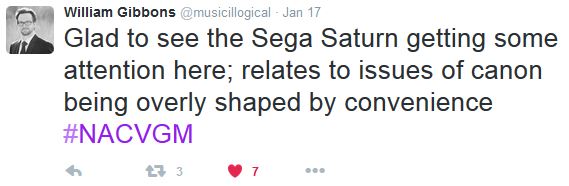
I wasn't able to attend this year's North American Conference on Video Game Music, but I did follow the tweets it generated. One of them got me thinking:

This touched off a brief conversation on Twitter, in which a few people wondered whether ludomusicologists respond to a canon that's already been established, or if we play a role in building or maintaining that canon, for good or for ill. I'd say that for me personally, my work responds to games that are accessible to me (either Mac/PC, or from older systems that are easily emulated), and games that I have a personal history with or connection to (again...Mac/PC or emulations of childhood games)

But it seems like we can study this problem by examining the kinds of games that receive scholarly attention. Do scholars stick mainly to games that are already well known, already in the 'canon' of video games? Or are we perhaps seeing a certain ludomusicological canon emerge, which may focus on different types of games, different platforms, etc.? Or is it simply too early to tell?

To that end, I started a Google Doc that weekend, which I've slowly added to in idle moments since. I'm trying to collect information about all the games studied by ludomusicologists in formal venues (conferences and publications). This is a pretty monumental task, though, and it seems more efficient to crowdsource it. So, I'm publishing this open link to the Google Doc where I've been collecting the information. So far, it's restricted primarily to conferences: NACVGM, the "Ludo" Conferences, as well as the video-game papers/sessions at SMT the past two years (posters, lightning talks, and the panel). It's got very few print sources in it so far, and only the ones that occurred to me off the top of my head.

So, I'm opening this up to all of you in ludomusicology land to add to as much as you can. Feel free to re-tweet widely!

A word on the organization: right now, things are organized by GAME, with some metadata, and then a list of studies secondarily. My hope is that, with the same data in a slightly different form, it will be easy to turn around and convert this into a bibliography of ludomusicology, which we could then add to the nascent bibliography hosted by the SMT's Film and Multimedia Interest Group. So, please feel free to add studies to this list as well. The order in which studies are listed is completely arbitrary: I have no sense that any given paper or presentation is the take on any game -- they're simply listed in the order that I added them (though I've since sorted the sheet by title of game).

Please feel free to update the existing information as well. Hopefully the metadata I've added are self-explanatory, though I should clarify: I've used the term "modern multi" to indicate the seemingly ubiquitous "PC/XBox_/PS_" label that many games carry. We can certainly be more particular, but this seems to indicate something useful, rather than creating tons of sortable columns for each system. XBox or PS exclusive, however, is a useful piece of information as well, and should be listed separately. Secondly, there are many [unknown] slots, which I use when I don't remember or don't precisely know the game(s) that a given study discusses. Please feel free to fill these slots in, or to move the attached studies accordingly, if you know the answers. I've also begun labelling genres, which seems useful. These are self-explanatory, but note that I've created two labels I haven't seen elsewhere: music game (for things like Guitar Hero) and more importantly "music game - abstract" for games like Otocky, Elektroplankton, etc. Please also feel free to add or correct metadata, invent your own keywords, add studies beyond the five per game for which I've currently created columns. Go wild. Behave yourselves.

I don't have any conclusions from this data yet -- feel free to draw your own, or leave them in the comments on this entry.

Here's the Google Doc, in case you didn't catch the link before: https://docs.google.com/spreadsheets/d/1kjwBUYLekeGuBuThpgO9cOCsydNlm4dKM27Hebh92T0/edit?usp=sharing


Comment